Updates
Our Creative Communities group has recently been awarded a five-year CAREER grant from the National Science Foundation to study and strengthen the important yet often invisible work of informal educators. Making and tinkering spaces in community-based organizations, libraries, and museums can provide the tools, materials, and social support for children, families, and community members to engage in transformative learning experiences. Behind the scenes, the informal educators (e.g. staff, volunteers, teen techs) who manage these spaces and learning experiences make many decisions from the displayed materials to the activity prompts to how they partner with organizations so that their community members feel welcome, take creative risks, and realize their goals.
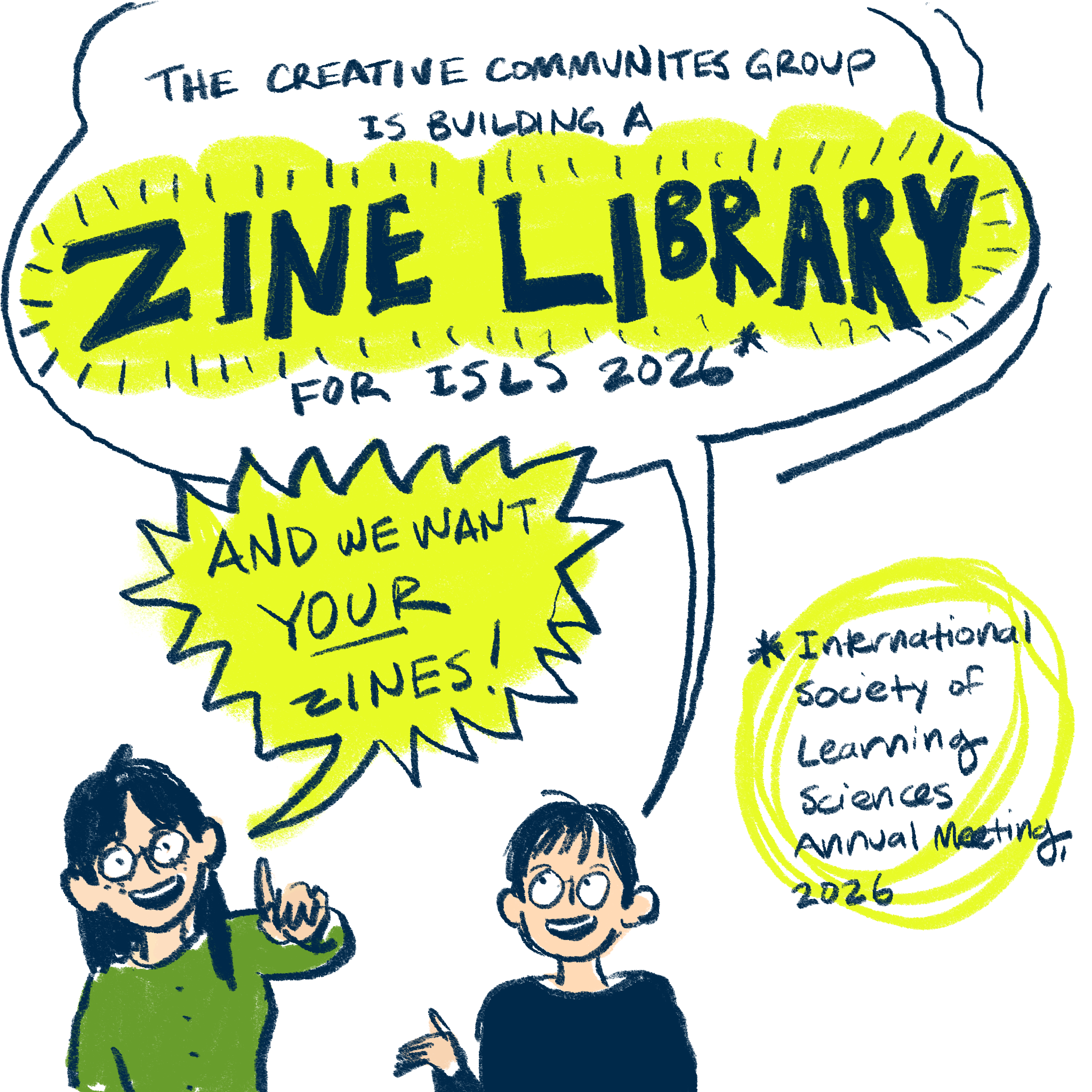
As a part of the new ISLS Arts Gallery & Performance track, we will be hosting a zine library and zine making table at ISLS 2026 in Irvine, CA! A zine (pronounced zeen) is a small-batch circulation of self published work, often in the form of text or images. They are easily reproducible and come in all shapes and sizes, but are most often seen in the form of a stapled or bound paper booklet. This zine library will be a display of zines made by the ISLS community and beyond, open for visitors to explore and read through as they please.
This blog post is dedicated to sharing more about how and why our group often uses pictorials to communicate our research. Pictorials are a research paper format accepted in several ACM (Association for Computing Machinery) venues in which “the visual components (e.g., annotated photographs, Artwork, collages, diagrams, field notes, illustrations, photographs, renderings, sketches) are the primary means of conveying information with at least, if not more, importance as the accompanying text.”
The Creative Communities research group in the department of Information Science at CU Boulder is seeking PhD students to join our team.
In the fall and spring semesters of last year, we took inspiration from the Facilitating Computational Tinkering project’s OctoStudio activity “Tinker with a View” and designed an activity we called “My Dream Colorado”.
Last month our team reconnected with our Denver Public Library ideaLAB collaborators at the newly opened Central Library branch. We gathered to share updates with each other from the last 6 months as well as a new resource for facilitators: Facilitation Cards. This blog post will focus on our experience reflecting on these cards together.
We’re excited to share a new resource called the “Now What: How can we be thoughtful about our next steps?” to better support educators in their implementation work within the infrastructural realities of their contexts. Check out the zine and the facilitator guide here and continue reading to learn about how we developed this resource.
If you are familiar with our work or have met our team at conferences, you may have come across our interactive “What Equity Means to Me” zine (formerly “Equity as a Moving Target”). We have more recently started sharing our “Now What” zine that focuses more on supporting the implementation and sustainability of learning innovations . Making and sharing these zines has been really rewarding for our team and met with so much enthusiasm from participants that we are currently scheming about how we can make even more.
Last month Mimi and I (Ronni) attended Play Make Learn (PML) in Madison, Wisconsin from July 17th-19th. Play Make Learn is an annual conference around the “design, research and practice of playful learning, games for learning and positive social impact, making and makerspaces, STEAM education, and arts in education. PML creates an inspirational space for preK-12 educators, designers, developers, innovators, librarians, museum professionals, makers, and researchers to tinker together, share knowledge, and celebrate one another’s work.”
Creating new activities and resources like activity guides are key parts of the Facilitating Computational Tinkering (FCT) Project. But what do you do when you discover something cool that isn’t quite ready to be turned into a guide? My answer is this: a “case study”. A case study documents the cool things we’ve learned with a good amount of detail in hopes that someone else might want to pick up these ideas and continue to tinker with them. This approach to sharing in-progress ideas is inspired by FCT collaborator the Tinkering Studio’s wonderful blog, which is described as a “virtual sketchpad to share our half-baked ideas and works in progress”.
Featured Project
Family Creative Learning is a workshop series that engages children and their parents to learn together — as designers and inventors — through the use of creative technologies. We designed the workshops to build on families' relationships and cultural backgrounds and to strengthen their social support and expertise around computing.